This year already ran the experiment on me once. On Friday, April 3, Anthropic announced that starting Saturday at noon, Claude subscriptions would stop powering outside agents. By Saturday night the forums were full of dead automation. Mine ran its overnight jobs and sent the morning briefing on time. Not luck. My workflows do not live inside anyone’s product.
And that Friday was not a one-off. Here is the year so far, dated:
Anthropic had a real problem: people paid $200 a month and burned thousands in tokens through agents that never sleep. The people building on it had a real problem too: six rule changes in six months. The Register, TechCrunch, and VentureBeat carry the receipts.
June 12 was the escalation
Look at the June 12 line. That one was not a pricing decision. The US government issued an export-control directive at 5:21pm Eastern, and Anthropic turned its strongest model off for everyone. For almost three weeks it did not exist as a product. Then it came back with a countdown: included in subscriptions for one week, then per-token from July 8, ten dollars per million tokens in, fifty out. Anthropic says the change is temporary and capacity-driven, and I believe it. It is still one more rules change, and this one landed while I was writing this essay.
I have no opinion about whether the directive was right. I have a design opinion. The people who can change your system’s rules overnight used to be one pricing team. This year that list grew to the pricing team, the legal team, and the state, and regulation is not loosening from here. That is too many outside hands on switches I depend on. The response I trust is to shrink what they can reach: control everything you can, and keep whatever you cannot control swappable.
The split
The habit that survived the year is one sentence: the vendor gets the thinking, I keep the knowledge.
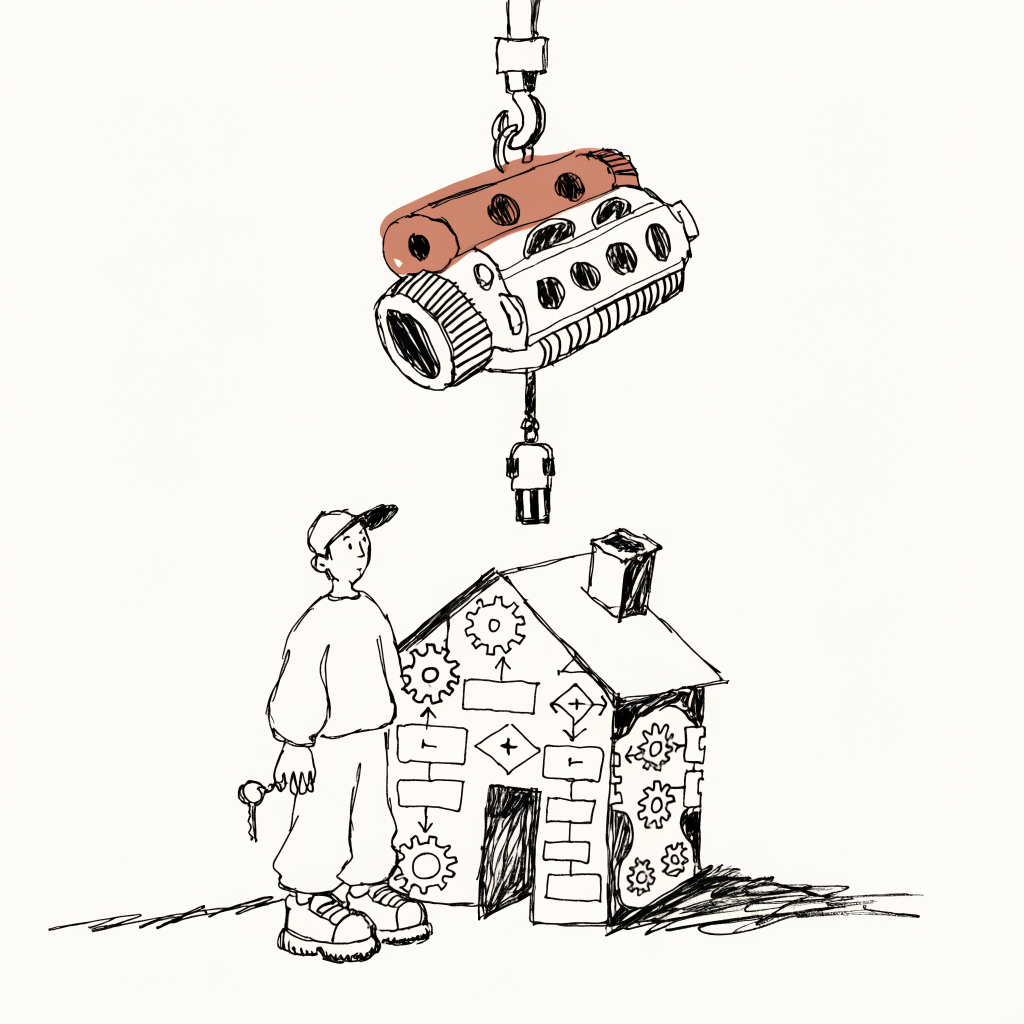
My agent does its day job inside Claude Code, on the $200 subscription, which is still the best deal in inference I know of. But everything durable lives outside it, on my own server, in formats no vendor controls: schedules in n8n, an open-source workflow tool; recipes and memory in plain files and SQLite; the agent’s abilities in a command line I wrote, 129 small commands with the approval gate in the exit code. The arrangement: work a task out with the agent, then freeze the working version where no rule change can touch it. The AI itself is one line of config, and a spare on a different vendor’s model stays warm behind it. When a scheduled job fails, the spare takes over before I am awake.
The split has a price, and I would rather list it than pretend. The vendor tools ship deep integrations I refuse to use, so I maintain my own gates and my own glue. Two models means two sets of quirks to keep tested. And renting the thinking still means a bad day when the spare model is worse. What the price bought is the April weekend and every rule change since. The harness study has the receipts from that stretch.
The part they actually want you to build on
The model alone is a commodity with a price tag, and both companies know it. The commitment they want is the layer above: agents living in their cloud, skills managed in their store, routines running inside their walls. I have not found a job the managed versions do that my boring stack cannot. The difference is that no vendor can reprice, re-term, or suspend mine. I wrote it in June: the pattern is right, the packaging is a fence.
The rented part is depreciating
The one part I rent may not stay special. I tested a five-dollar-a-month model against human professionals on real work from 44 occupations: 76 to their 84, and it matched or beat the professional on 23 tasks. In my 19-model test, a cheap model matched the best one at a sixty-sixth of the cost. The frontier models are still better, and I pay for one. But the gap is the smallest thing I have ever paid $200 a month for, and it keeps shrinking. There is a real chance this ends on open source. If it does, the people who own their workflows point them at the free engine and keep going, and the people who built inside a vendor’s walls start over.
The honest hedge: open models are not a safe harbor yet either. The strongest ones mostly come out of Chinese labs, including the two I lean on, the spare behind my agent and the five-dollar model in that test. The prices are absurd in the good way. What nobody can tell you is exactly what is inside: what a model was quietly trained to do can survive safety training and testing undetected, and how they hold up against prompt injection is still open research. So the cheap models run where the blast radius is small, behind the same gates as everything else. The only models I fully control today are the small ones on my own hardware: the embeddings and the voices.
It is a precarious stretch, and I am not going to pretend otherwise. The vendors are moving, the state is moving, and the open alternative is promising and half-known. The next rule change might come from a pricing meeting, a legal team, or a federal directive with a timestamp, and you will get the warning I got in April: none. So run the test on your stack once. If one rule changes on a Friday, what still runs Saturday at noon? In April my answer was the overnight jobs and a briefing arriving before I woke up. I intend to keep the answer boring.
The deeper layers, for the curious formats, hooks, and a moving system prompt
The optimistic half of the story: the file formats went open. Anthropic published its skills format, folders of plain markdown that teach an agent a procedure, as an open standard in December 2025; Simon Willison called the spec “deliciously tiny.” OpenAI’s AGENTS.md instructions file spread the same way, and Anthropic, OpenAI, and Block co-founded a foundation under the Linux Foundation to hold the shared parts. A skill written today runs in Claude Code, Codex, Gemini CLI, and the open-source agents. One wrinkle: Claude Code itself still does not read AGENTS.md, the standard everyone else adopted.
What stays locked is one level down. Claude Code exposes about thirty lifecycle hooks with no real equivalent in other tools, so automation built on them is a rewrite if you leave. And the context itself moves: the system prompt and tool definitions change with every release, with a public diff tracker measuring swings of fifty to ninety thousand tokens between versions. Mario Zechner left Claude Code over exactly this, concluding “my context wasn’t my context.” He ships a rival tool, so weigh that; the diff tracker has no side.
The vendors also split on purpose. OpenAI invited outside agents onto its subscriptions, Sam Altman’s words: “happy lobstering.” Armin Ronacher’s read is that the lab that is ahead locks the door and the lab that is behind props it open. The dated record fits.
Some operational details in these essays have been changed for narrative or privacy reasons. The arguments, the numbers, and the lessons are real.