BUILD RECORD
vLLM Video Intelligence
A contact-sheet pipeline made it cheap enough to extract useful data from an entire video library.
Reading one video with a vision model cost about eight cents, which kills anything meant to read a lot of them.
Cost was the call count, so it made fewer calls.
vLLM Video Intelligence
Retired
A video-analysis engine that tiled eight frames into one contact sheet, so cost stopped tracking length.
Reading a video went from about eight cents to under a penny, about a tenth of the cost. That made a free audit of a whole account possible.
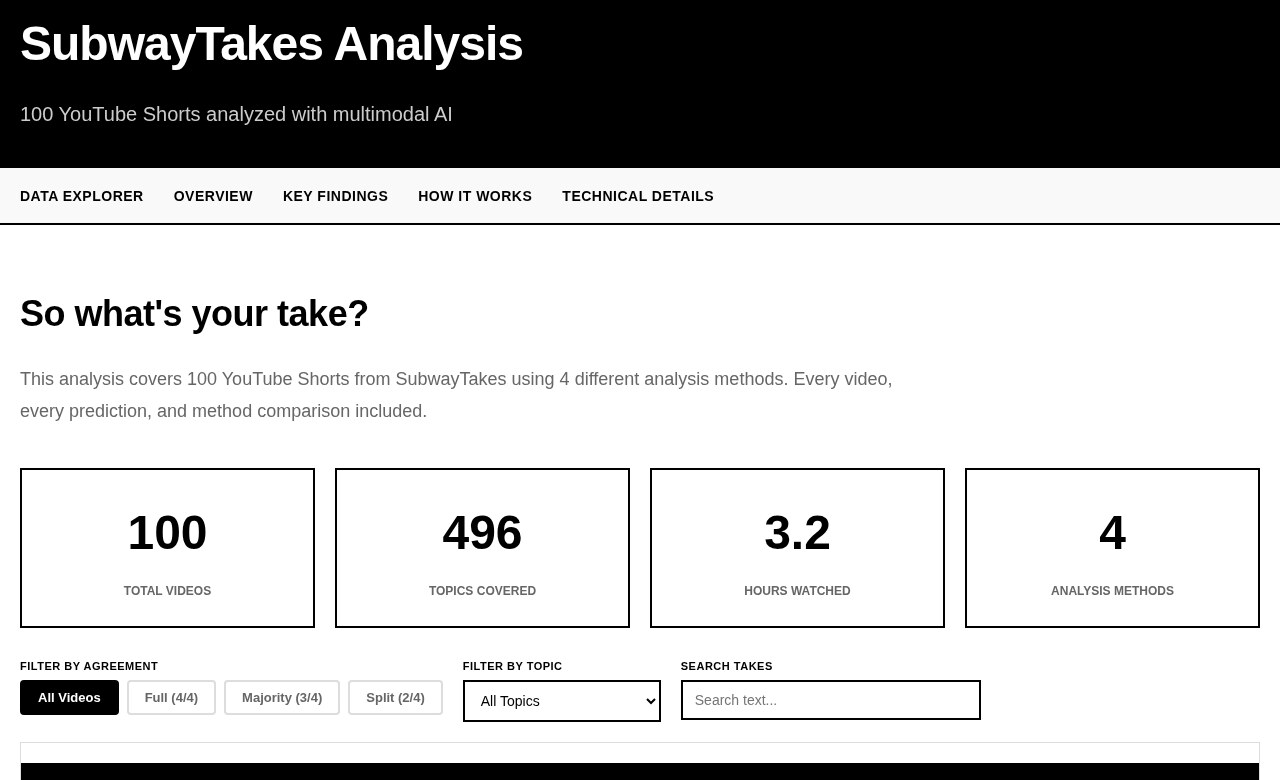
100 Shorts from one channel, read in seven minutes for about 70¢.
contact sheets GPT-4.1-mini Gemma 27B Whisper
Architecture, tiling engine, model comparison, explorer.
Open source, released with the run's own explorer, every prediction still browsable.
THE EXPLORER
What came out of a video
The explorer: 100 videos, 496 topics, 3.2 hours watched.
THE METHOD
Video became data
video · the path to data
sampled · tiled · read · returned
A frame every couple of seconds, near-duplicates dropped.
Eight went to an image, turning forty calls into three to five.
GPT-4.1-mini and Gemma 27B read the sheets; Whisper read the audio.
It returned topics, transcript, and whether the two models agreed.
LIMITS
What it refused to do
• It sampled, so anything between two samples never reached a sheet.
• GPT and Gemma agreed about 85% of the time. Stability, not accuracy.
• One channel of short interviews, not a general rate.
RECORD AND LINEAGE
Where the engine went
Retired. Built and open-sourced solo.
FrameIQ, the same sheets across a whole account.
Doorbell Intelligence, contact sheets pointed at a doorbell's own recordings.
THE ARCHITECTURE

EXAMPLES
A RELATED PROBLEM
Is the cost of each model call blocking the product?
This build is retired, but the unit-economics problem remains. If the job is to understand a large video corpus without paying per frame, send it over.