BUILD RECORD
FrameIQ
Every video on the account, read as data, collapsed into one strategy. The useful signal was in the pattern across the whole video library, not in one post at a time.
PRODUCT BUILD
Every video on the account, read cheaply enough to be free.
FrameIQ
Retired · built and shipped solo
Video intelligence: every video on a creator's account, screen and audio both.
Made a whole-account audit cheap enough to give away. Reading a video fell from eight cents to under a penny, about a tenth of the cost.
Every video on the account, not a sampled few. Shorts, TikTok, and Reels, never averaged.
One tiled image per call, two vision models reading it.
Solo. Product, video engine, vision pipeline, beta.
Public beta: a free whole-account audit, a strategy in a day.
THE BETA
What a creator got back
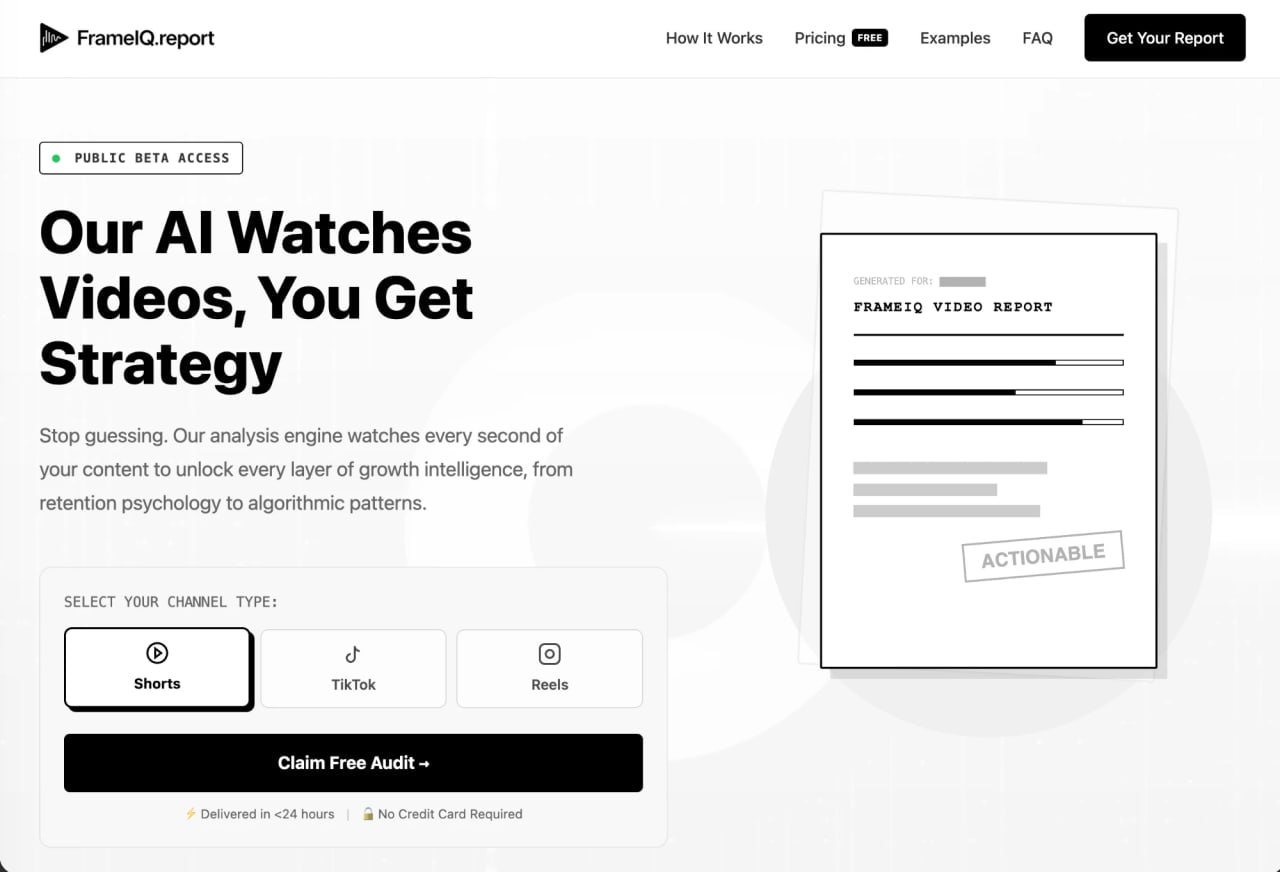
frameiq.report: the second-by-second read, one grade per platform.
THE METHOD
An account to a strategy
01 Took the whole account
It took every video on the channel.
02 Read each one cheaply
It sampled frames, dropped near-duplicates, and tiled survivors eight to a sheet.
03 Pulled the data out
It pulled hook, pacing, on-screen text, framing, energy, and where attention broke.
04 Collapsed the account
It collapsed repeating patterns, and graded them for one platform.
A wall of per-video observations is not a strategy. The work was deciding what to drop.
LIMITS
What it did not do
It never read every frame, only the ones that differed.
One platform at a time. Shorts and Reels got different answers.
Strategy, not prediction. It described the creator's own posts.
No sign-up, so nothing to hand over. Channels and outputs unpublished.
RECORD AND LINEAGE
The engine outlived the product
An engine I open-sourced, recorded at vLLM Video Intelligence.
THE ARCHITECTURE

EXAMPLES
A RELATED PROBLEM
Need to understand a library, not just one file?
This build is retired, but the pattern remains. If your useful evidence is spread across a whole media library, I can help make it inspectable.