The claim I am responding to
Harrison Chase of LangChain has been making a precise distinction this year: n8n is a workflow builder, not an agent. In an n8n flow a human draws the control flow ahead of time. The boxes and arrows are fixed. The LLM fills in a node here and there, but it does not decide what runs next. An agent, in his framing, is the opposite: the model decides the control flow at runtime, step by step, based on what it sees.
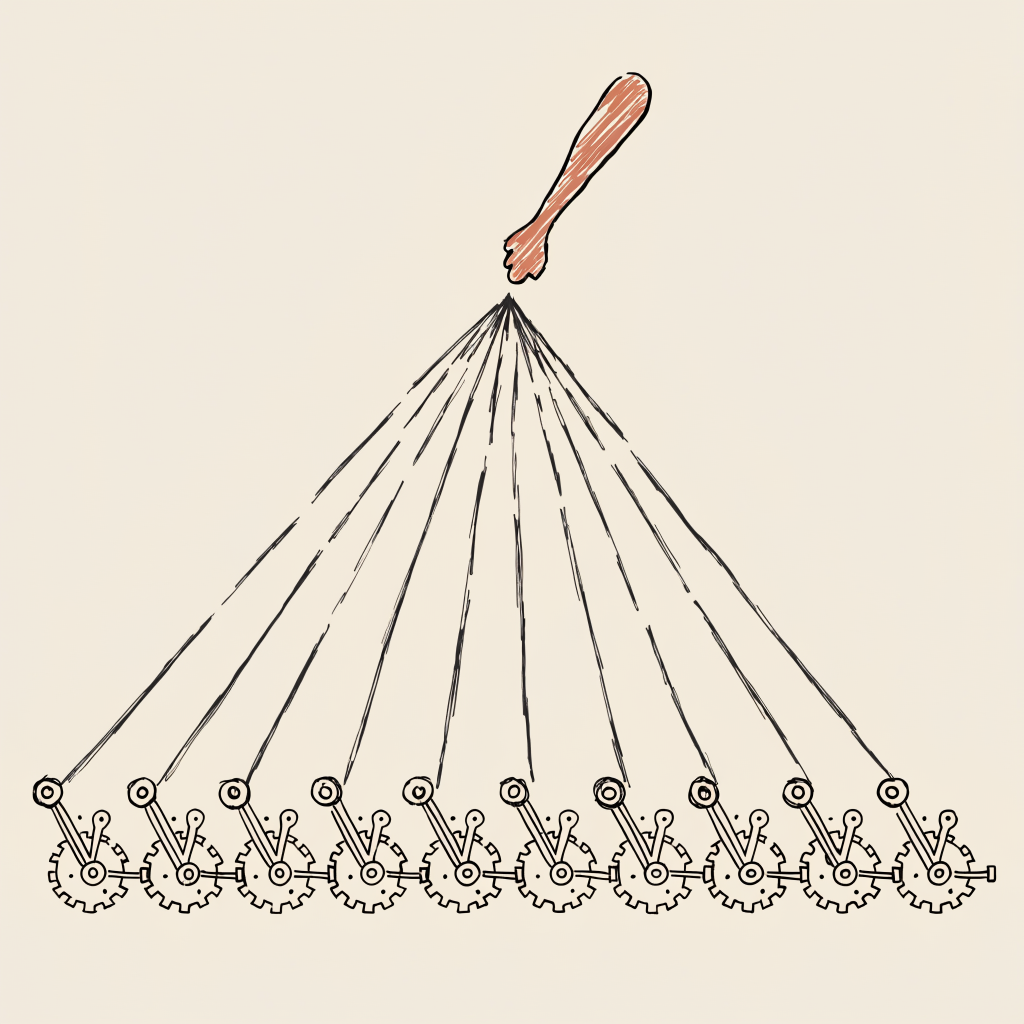
He is right about the mechanics, and I run n8n anyway. The disagreement people read into that is not a disagreement. It is a category error about which component is the orchestrator. So let me state the position this site argues, in his own vocabulary: the model is the orchestrator. The workflow engine is one of its tools. The flow Chase describes, the fixed boxes and arrows, is not my agent. It is a thing my agent calls.
What I agree with
I agree that a drawn workflow is not an agent, and I agree it should not pretend to be one. The failure mode Chase is warning against is real: teams wire an LLM into the middle of a rigid n8n flow, call the whole diagram an "agent," and then wonder why it cannot recover from anything the diagram did not anticipate. The diagram is deterministic. The intelligence is bolted on. That is a workflow with an LLM in it, not an agent, and the naming matters because it sets the wrong expectation.
This is the same place Anthropic landed in Building Effective Agents (Erik Schluntz and Barry Zhang, December 2024). They draw the line explicitly: workflows are systems where LLMs and tools are orchestrated through predefined code paths; agents are systems where the LLM directs its own process and tool usage. Two different things. Chase is policing the boundary between them. So am I. We just route the boundary through different boxes.
What I see differently
Where I split from the common reading is on which box is in charge. The instinct, once you accept that n8n is "just" a workflow builder, is to demote it: the model is the smart part, n8n is the dumb plumbing underneath, and a real agent system needs something more agentic than n8n at the top. That instinct is what pushes teams toward agent fleets, a planner agent over a worker agent over a tool agent, each one supposedly more autonomous than a workflow node.
It is the wrong move, and Anthropic named why before I had the production data to confirm it. The same essay introduced the orchestrator-workers pattern: a central LLM dynamically breaks down a task, delegates the pieces, and synthesizes the results. The orchestrator is a model, not a diagram. The workers are tools, not peers. There is exactly one locus of decision. Everything else executes.
Read that pattern next to Chase's distinction and the resolution is clean. n8n is not competing to be the orchestrator. It cannot be, by Chase's own definition, because it does not decide control flow at runtime. So stop asking it to. Let the model be the orchestrator, the one component that decides, and let n8n be the largest of the workers: the hands.
The vocabulary that makes this precise
Anthropic's engineering writing has converged on a way of talking about this that I have adopted wholesale, because it names the seam exactly where it falls. They talk about decoupling the brain from the hands, and about three layers: the brain (the model doing the reasoning), the hands (the tools that touch the outside world), and the session (the loop and context that holds them together across turns). The brain is the only part that decides. The hands are the only part that acts. The session is what keeps the brain coherent while the hands are busy.
Map my system onto that and there is no ambiguity left. The brain is one Claude loop. The hands are roughly thirty tools, and the biggest hand by far is n8n. The session is the context-engineering and memory machinery that lets that one loop run for months without losing the thread. n8n is unambiguously a hand. A very strong, durable, scheduled, branching hand, but a hand. It never gets to decide. It gets told.
What my operational data adds
Here is the part Chase and Anthropic, writing as a framework author and a model vendor, are not positioned to supply: the bill from running it. I have run one Claude agent in continuous daily production since October 2025. Across a 46-day window the system executed 6,442 jobs at a 93.9% completion rate, $0.032 per job, about $205 a month. The agent routed across six model families with automatic fallback. n8n carried every piece of work that had to outlive a single context window: scheduled cadence jobs, branching content pipelines, durable retries.
The finding that reorganized how I build came out of the harness study underneath those jobs: across 197 scored runs over 19 models, swapping the model moved output quality by as much as 37x, while swapping the harness around it barely moved the same task at all. The decision layer is the model. The execution layer is interchangeable plumbing. That is the same brain-and-hands split, measured. If the hands were the orchestrator, harness choice would dominate the numbers. It does not. The brain dominates by 37 to 1.
This is also why the agent-fleet framing fails on the ledger, not just in theory. A second agent is a second brain. Two brains have to reconcile their decisions, and as Cognition's Walden Yan documented in Don't Build Multi-Agents, every action carries an implicit decision, so conflicting actions carry conflicting decisions you then have to referee. Adding hands is cheap and safe: a new tool cannot disagree with the model, it can only succeed or fail. Adding brains is expensive and unsafe. So I add hands. n8n is the largest hand I have added.
Where this position borrows from durable-execution
The cleanest precedent for "let the engine be the hands" is not in the agent literature at all. It is in Temporal, the durable-execution system that predates the current agent wave. Temporal splits a program into workflows (deterministic orchestration that must replay identically) and activities (the non-deterministic work that touches the world: network calls, side effects, anything that can fail and be retried). The discipline is that activities never decide control flow; the workflow does, and it does so deterministically so it can be resumed after a crash.
n8n is doing the activity job, not the workflow job, in my architecture. The non-deterministic decision, what to do next, lives in the model. The durable, retryable, scheduled execution lives in n8n. I borrowed Temporal's separation and moved the decision boundary up one level: the orchestrator is no longer deterministic code, it is a reasoning model, and n8n becomes the durable activity layer that model reaches for. The orchestrator-workers pattern is Temporal's workflow-and-activities split with an LLM promoted into the workflow seat.
What this position adds, stated plainly
Chase is right that n8n is a workflow builder and not an agent. The correct conclusion from that is not "use something more agentic than n8n." It is "stop expecting the workflow engine to be the orchestrator, and put the model there instead." One brain. Many hands. The brain decides, the hands act, the session holds it together. n8n is the biggest hand, and being a workflow builder rather than an agent is precisely the property that qualifies it for the job.
If you are building this: draw the line once, at the brain-hands seam, and never let it drift. Anything that decides goes in the model. Anything that acts goes in a tool, and durable or scheduled action goes in the workflow engine. The first time you feel the urge to add a second decider to "coordinate," check whether you actually need another hand instead. You almost always do, and a hand cannot argue with you.
Related on this site
The works this position is in conversation with are linked inline above, where they earned the point. The operational data behind the claims lives here:
- 6,442 jobs later: model selection beats harness choice 37 to 1. The benchmark and the 37x finding the brain-dominates argument rests on.
- From a fleet of agents to one agent: what changed and why. The milestone note on why a second brain was the wrong scaling move.